PrivacyScrub V5 – End-to-End Video Anonymization for Faces and License Plates
Project in One Sentence
PrivacyScrub V5 is a cloud-native video anonymization service that ingests user-uploaded footage, detects and tracks sensitive entities, and emits a redacted, share-safe video asset suitable for compliance-sensitive environments.
Business problem:
- Government and compliance-bound teams sit on bodycam, dashcam, surveillance, and workplace footage they cannot release or reuse until privacy obligations are met, and manual frame-by-frame redaction does not scale.
- Commercial teams face the same problem with screen recordings and training footage.
V5 outcome:
- Turned an experimental YOLO script from earlier versions into a resilient pipeline with job state, chunking, GPU workers, and CI/CD gating to prevent unsafe deployments.
1. Context and Objectives
Use case: Enable analysts, engineers, and content creators to safely share or store video that originally contained PII (faces, license plates, sensitive regions) without manually editing every frame.
Constraints I designed for:
- Handle multi-minute videos without timeouts by splitting into chunks and stitching at the end.
- Support GPU acceleration for heavy detection workloads, but keep the control plane lightweight.
- Guarantee idempotent job handling so repeated uploads or retries do not corrupt state.
- Make the anonymization defaults conservative enough for privacy, but configurable for power users.
Primary objectives for V5:
- Upgrade from “single-shot YOLO pass” to a full detection + tracking + re-identification pipeline over time.
- Introduce clear job lifecycle states (QUEUED, CHUNKING, PROCESSING, STITCHING, COMPLETED, FAILED).
- Guard changes with SRS+TDD assets and shift-left CI checks so regressions are caught before deploy.
2. Solution Overview (V5)
2.1 End-to-End Flow
The V5 system is a Cloud Run–based microservice architecture with a Streamlit front end, FastAPI gateway, background workers, and a persistence layer on GCS and Firestore.
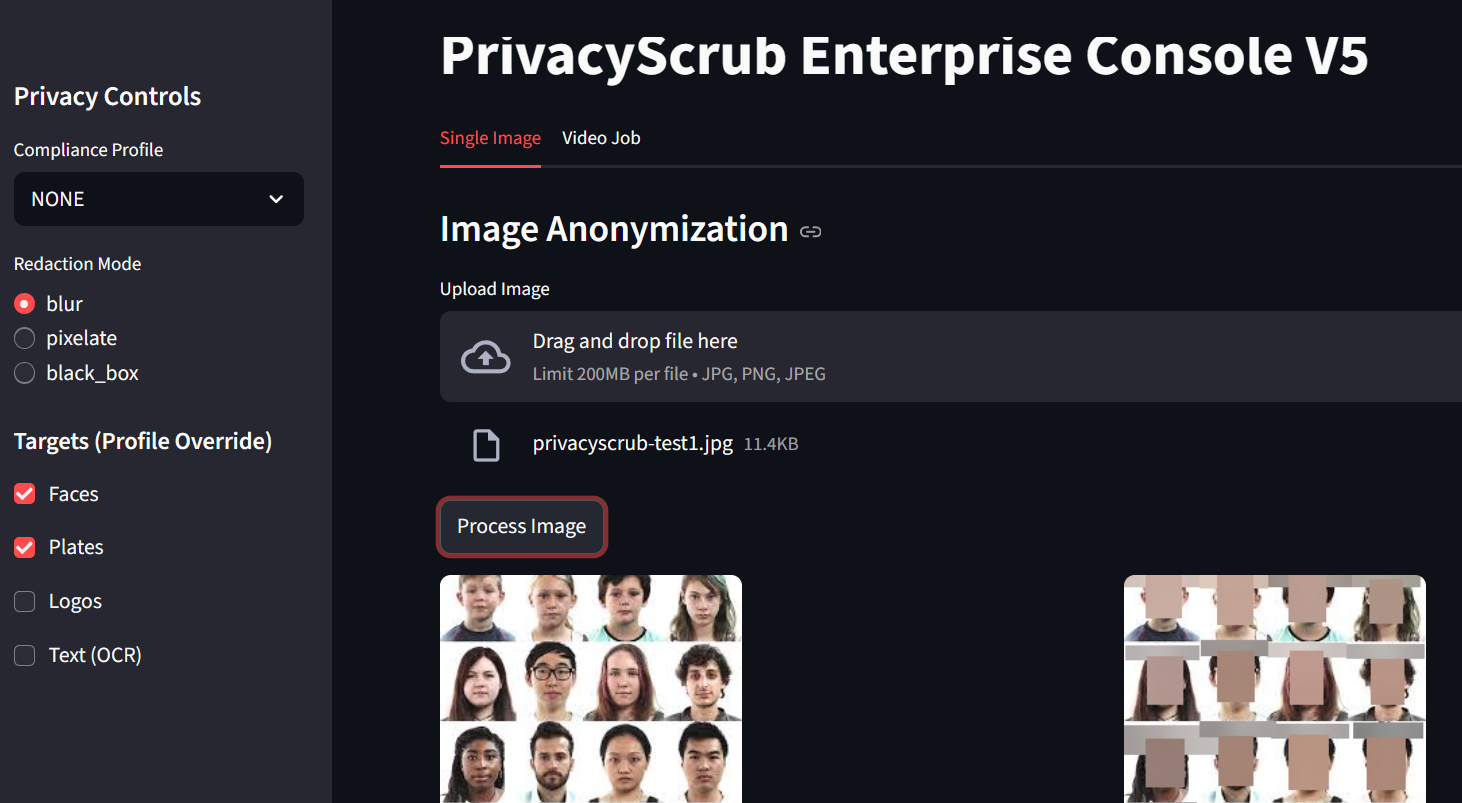
- Frontend: Streamlit app for file upload, job submission, status polling, and result download.
- API Gateway (FastAPI): Receives uploads, writes raw video to GCS, creates a job record in Firestore, and enqueues work.
- Orchestrator Worker: Downloads the original, runs FFmpeg to split into manageable chunks, and dispatches per-chunk processing tasks.
- GPU Worker: Uses YOLOv8-X, face, and plate models plus DeepSORT/Re-ID to track identities across frames and apply consistent anonymization.
- Stitching: Once all chunks complete, the orchestrator concatenates them, strips metadata, writes the final redacted video, and marks the job as COMPLETED.
2.2 Anonymization Operations
At V5, the pipeline supports a wide set of anonymization features:
- Face and license plate detection using YOLOv8-family models.
- DeepSORT-style tracker associates detections across frames, handling occlusions and re-entries.
- Re-ID embeddings ensure a single person or vehicle receives consistent anonymization across the clip, even if they temporarily leave the frame.
- Configurable anonymization policies by class (for example, blur faces, solid-mask plates, optional full-body masking).
- Bounding box smoothing and temporal interpolation to avoid flicker at detection boundaries.
2.3 Architecture Diagram
The following architecture diagram is referenced in both the portfolio and GitHub README:

2.4 Key Technologies
3. Evolution from V1 to V5
PrivacyScrub went through multiple iterations before landing on the current V5 architecture. I captured the evolution in DM, SRS, TDD, and implementation documents for each version.
- V1: Single-script YOLO detector running locally, anonymizing faces and plates frame-by-frame with minimal error handling.
- V2: First API wrapper and simple UI; still largely synchronous, not robust to long videos or failures.
- V3: Split into a more explicit service plus job abstraction; early experiments with queues and state tracking.
- V4: Introduced stronger separation of roles (gateway vs worker), chunked processing for longer clips, and improved error handling.
- V5: Added GPU-first worker design, re-identification tracking, chunk-aware stitch pipeline, better idempotency, and Terraform-backed infrastructure definition.
This case study focuses on the final V5 design, but the documentation set in the repository (docs/DM - Personal - PrivacyScrub V5.pdf, SRS+TDD - Personal - PrivacyScrub V5.pdf) captures the full progression.
4. Technical Highlights
4.1 Detection, Tracking, and Re-Identification
- YOLOv8-X as the primary detector for faces, plates, and optionally full-body regions.
- DeepSORT-style tracker associates detections across frames, handling occlusions and re-entries.
- Re-ID embeddings ensure a single person or vehicle receives consistent anonymization across the clip, even if they temporarily leave the frame.
- Configurable anonymization policies by class (for example, blur faces, solid-mask plates, optional full-body masking).
4.2 Chunked Processing and Stitching
- FFmpeg used to split large uploads into uniform segments to avoid timeouts and memory issues.
- Each chunk is processed independently by the GPU worker; re-ID metadata can be carried forward when needed.
- Final stitching step concatenates processed chunks, normalizes codecs, and strips Exif/metadata to avoid accidental leakage.
4.3 Resilience, Idempotency, and State
- Firestore keeps a per-job document with state, progress counters, timestamps, and error details.
- Workers are written to be idempotent: reprocessing a chunk or job does not corrupt downstream state.
- Jobs move through a defined lifecycle: QUEUED → CHUNKING → PROCESSING → STITCHING → COMPLETED or FAILED.
4.4 Infrastructure as Code and CI Guards
- Terraform configuration for Cloud Run services, IAM, and core storage resources.
- SRS+TDD assets formalize requirements and test coverage for each version, especially V5.
- Automated tests validate detection, anonymization integrity, and basic video sanity before deploy.
5. Results and What I Shipped
5.1 Outcomes
- Delivered a working demo where non-technical users can upload video and download a redacted version without touching code.
- Improved stability over earlier versions by isolating long-running work into background GPU workers with clear job state.
- Produced reusable documentation (DM, SRS, TDD, and case study) that shows how I think about secure, privacy-first ML systems.
5.2 Lessons Learned
- Chunked processing and tracking must be designed together; naïve chunk boundaries can break anonymization consistency.
- Detectors that perform well on single images can still produce jitter across video; temporal smoothing is critical for a professional feel.
- Having a clear job lifecycle model (and a real data store behind it) pays off quickly in debugging and user experience.
5.3 My Responsibilities
- Defined problem scope, threat model, and anonymization requirements.
- Designed the V5 architecture and job lifecycle, including chunking and stitching strategy.
- Implemented the FastAPI backend, worker logic, and integration with YOLOv8, tracking, and FFmpeg.
- Built the Streamlit front end for demo, job submission, and download.
- Created Terraform infrastructure definitions and SRS/TDD documentation.
- Authored the portfolio case study and one-page recruiter summary.
6. Links and Assets
This project appears in the portfolio under /PrivacyScrub_V5 with the following assets:
- Case study (HTML): Burns_Greg_CS_PrivacyScrub_V5.html
- One-page recruiter summary (PDF): Burns_Greg_CS_1P_PrivacyScrub_V5.pdf
- Architecture diagram: Burns_Greg_CS_PrivacyScrub_V5.svg
- UI screenshot: Burns_Greg_CS_PrivacyScrub_V5_screen.png
Full design and engineering documentation (DM, SRS, TDD for V1–V5) is stored under docs/ in the GitHub repository.