Overview
Teach-by-Doing (TbD) V6 is the ingestion and understanding engine for FreeFuse’s
Pathways-as-Data platform. It converts expert behavior captured in video into a structured,
temporal graph of steps, transitions, and metadata called a Pathway. The same
artifact can be used as:
- Human-facing documentation – clear, step-by-step instructions.
- Training data – labeled trajectories for LLM agents and automation.
- Robotics integration – a semantic “script” for embodied systems.
Problem Context
Most organizations have critical know-how trapped in unstructured formats: recorded Zoom calls, tutorial videos, tribal knowledge, and brittle SOPs nobody maintains. That creates three compounding gaps:
- Data Gap: No consistent, labeled “unit of work” for training AI agents.
- Tech Gap: Experts can’t (and shouldn’t) encode workflows as state machines.
- Strategy Gap: Without a standard format, there is no ecosystem or marketplace for reusable workflows.
TbD is designed to bridge all three by turning unstructured “doing” into structured Pathways-as-Data that can sit at the heart of automation, continuous learning, and robotics.
Version Evolution (V1 → V6)
TbD V6 is the culmination of several iteration cycles. Each version added a missing layer of realism or capability:
-
V1 – Local MVP: Basic video ingestion, scene detection, and
pathway.jsonexport using a “bridge stack” of OpenCV + OCR. Proved the concept that video could be turned into steps. - V2 – GCP Fan-Out: Moved ingestion to a scalable cloud pattern with GCS, Pub/Sub, and per-segment processing, making longer videos feasible.
- V3 – Semantic Enrichment: Added LLM-driven captions and step descriptions so the resulting pathways read like rich expert documentation instead of raw frames.
- V4 – Temporal Grounding: Introduced a temporal encoder (LSTM-style) to capture sequence, dependencies, and multi-step context, not just isolated moments.
- V5 – Compliance & Metadata: Added stronger metadata, depth perception, and hooks for compliance frameworks (e.g., AS9100-style traceability).
- V6 – Pathways-as-Data Engine: Unified API, stable PAD schema, temporal embeddings, and a cohesive backend powering a Streamlit demo and downstream systems.
Architecture
TbD V6 is implemented as a cloud-native pipeline that ingests video, detects meaningful
changes, enriches them with semantics and temporal context, and exports a single
Pathway artifact that any downstream system can consume.

Pathway.json for
humans, LLM agents, and robotics workflows.
Key Responsibilities by Stage
- Ingestion: Accepts source videos from SMEs (screen captures, task recordings) and normalizes them for processing.
- Segmentation: Uses computer vision (optical flow, SSIM) and heuristic cues (UI changes, cursor movement, pauses) to identify candidate step boundaries.
- Semantic Enrichment: Calls an LLM to describe each candidate step, expanding from “frame X to frame Y” into a natural-language explanation plus key fields (action, object, tools, preconditions).
- Temporal Encoding: Runs a temporal encoder over the ordered steps to learn transitions, branching, and dependencies, yielding a contextual embedding for each node.
-
PAD Export: Writes out a
PathwayJSON object with nodes, edges, timestamps, metadata, and temporal vectors, ready for orchestration, simulation, or documentation.
Demo Experience
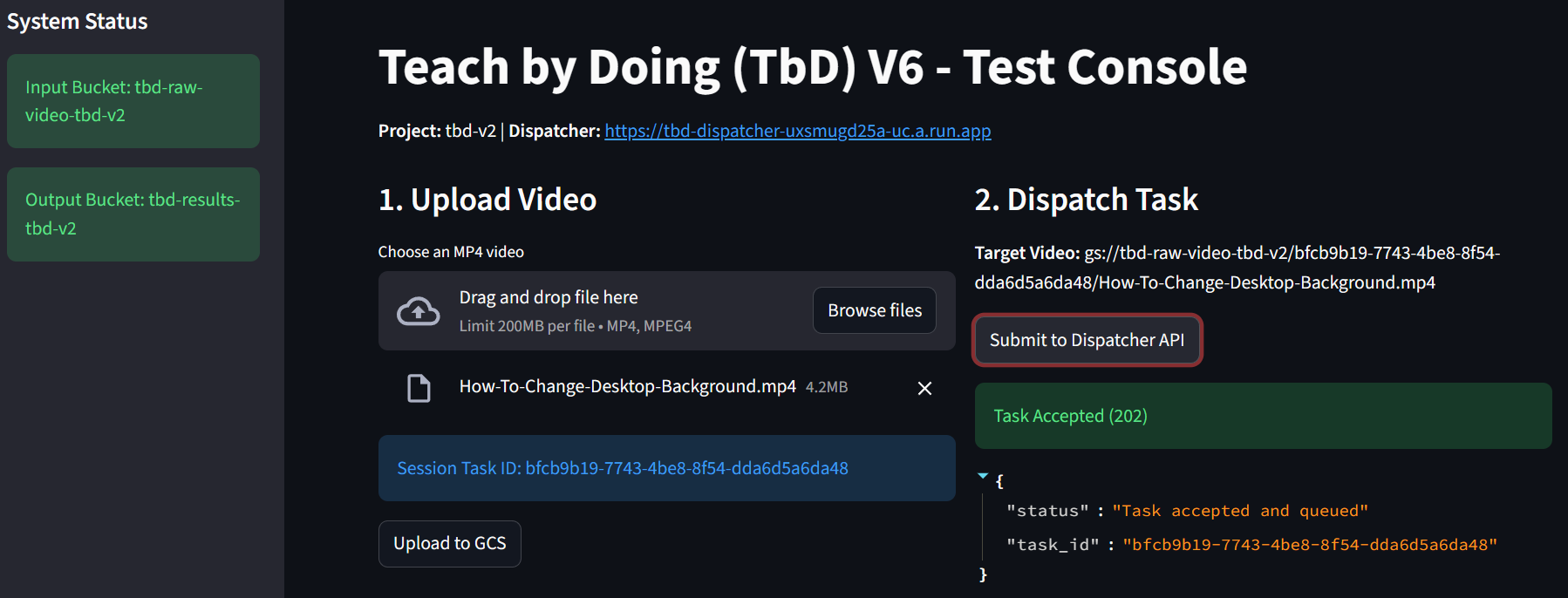
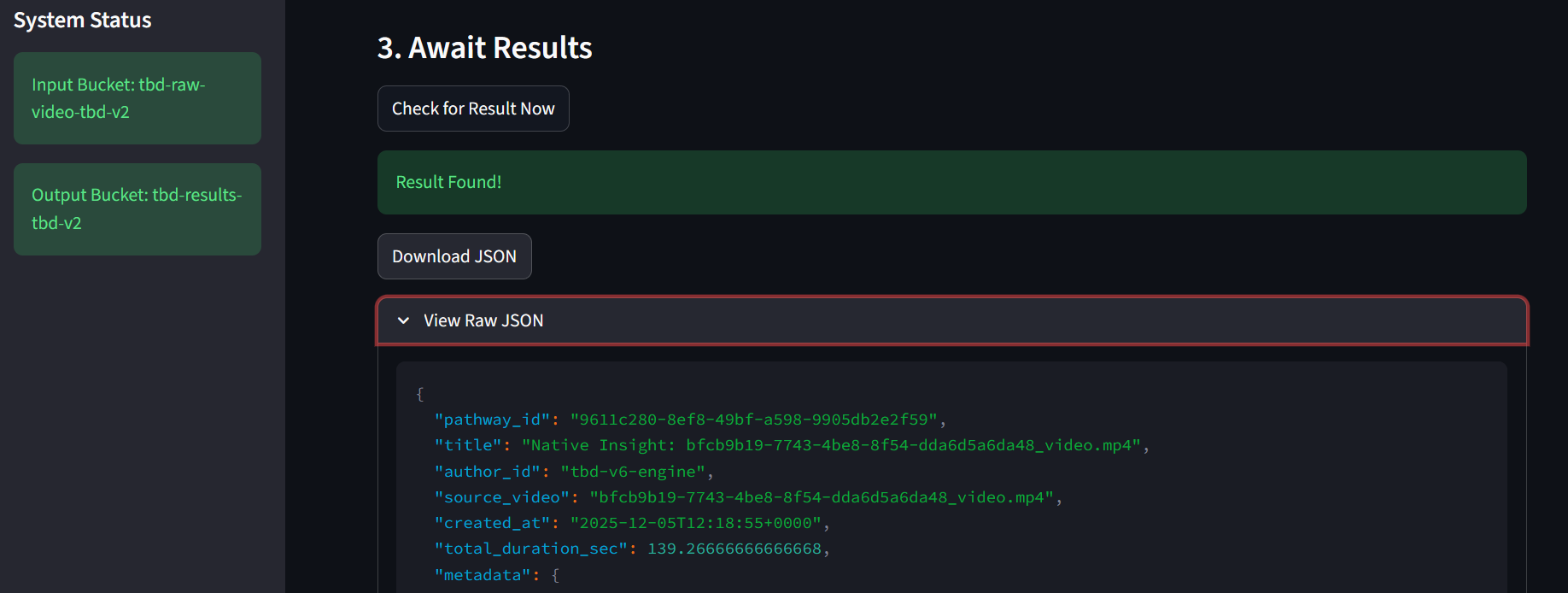
The TbD V6 Streamlit demo exposes the core engine in a way that non-engineers can immediately understand: upload a clip of a task being performed, then inspect the generated pathway as a visual and JSON artifact.
Typical User Flow
- An expert records themselves completing a task (e.g., configuring software, assembling a part).
- The video is ingested into TbD V6 via the UI or API.
- TbD segments the video into discrete steps, describes them, and encodes transitions.
- A
Pathway.jsonfile is produced and can be viewed, edited, or passed downstream. - That Pathway can now power documentation, agent guidance, or robotics routines.
Implementation Highlights
1. Computer Vision + Heuristic Segmentation
- Uses SSIM and optical flow to detect meaningful visual changes between frames.
- Combines frame-level signals with domain heuristics (e.g., cursor pause, UI transitions) to infer step boundaries.
2. LLM-Based Semantic Layer
- Frames around each boundary are summarized by an LLM, generating human-readable step descriptions.
- Prompts extract structured fields (verb, object, tools, context) to populate PAD schema fields.
3. Temporal Encoder for Pathway Intelligence
- A temporal model (e.g., LSTM-style encoder) processes the ordered steps to learn how they relate over time.
- Produces embeddings that capture sequence, branching, and context, which is crucial for agents and robotics.
4. Pathways-as-Data Schema
- Each pathway is stored as a JSON object with nodes, edges, timestamps, and metadata.
- Supports multiple “views”: human documentation, analytics, and machine execution.
Impact & What This Demonstrates
TbD V6 demonstrates how to turn messy, unstructured behavioral data into a clean, standardized asset that can drive multiple lines of value:
- Operational: Generate living SOPs without forcing experts to write documentation.
- Training & AI: Supply rich, labeled trajectories for LLM agents and copilots.
- Robotics & Automation: Provide high-level semantic scripts that can be mapped to skills.
From a skills perspective, TbD V6 showcases my ability to think and build at the level of platforms: designing schemas, temporal models, and pipelines that are useful to humans, software, and hardware all at once.
Assets
- GitHub Repository: github.com/burnsgregm/TbD-V6
- Live Demo: tbd-v6.streamlit.app
- Case Study 1-Pager: Burns_Greg_CS_1P_TbD_V6.pdf
- Workflow Diagram: Burns_Greg_CS_TbD_V6.svg